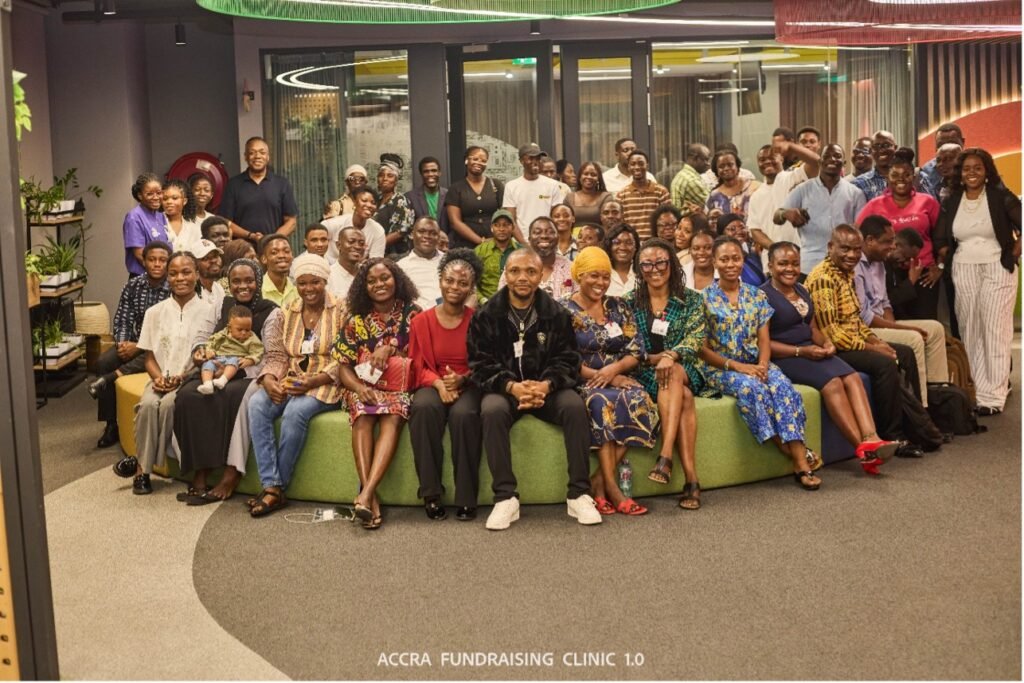
Official Development Assistance to Africa fell 9% in 2024, and the 2025 USAID funding freeze ended hundreds of programs almost overnight. Yet many African nonprofits still operate on a model designed for abundant foreign aid. The first Accra Fundraising Clinic set out to ask a harder question than “Where is the next grant?” It asked: what resources, relationships and systems already exist around us, and how do we build on them?
Civil society organisations, youth-led groups, practitioners and social-impact actors came together for a day of practical learning and peer feedback. This post summarises what mattered most, and why the conversation needs to continue.
Key takeaways
Fundraising is relational. Research the funder and build the relationship before making the ask.
Partnerships must create additional value, and they need active management after the agreement is signed.
Faith institutions, local businesses and communities are underused sources of domestic resource mobilisation.
AI saves time, but only when used iteratively and verified by people.
Alternative funding models reduce grant dependency, and the right model depends on mission, capacity and context.
Why this clinic, and why now
At the start of the day, participants described what they wanted to change. They spoke of moving beyond one-off grants, expanding corporate sponsorship, and knowing what to do when donors are not knocking on the door. Others wanted to understand Ghana’s changing funding environment and how young organisations can navigate established partnership systems.
These were not requests for money. They were requests for systems. That distinction shaped everything that followed.
Keynote: rethinking resource mobilisation
Tanko Ibrahim, Executive Director of STAR-Ghana Foundation, opened with a candid observation. The development sector and its funding infrastructure are in transition, and approaches once considered predictable are being disrupted. His advice was to experiment, learn and adapt, rather than assume that yesterday’s methods will work today.
Three practical lessons stood out:
- Understand the donor. Learn their priorities, language and strategic objectives, then show how your work connects to them.
- Build relationships before asking. Take genuine interest in what a prospective partner already does and look for ways to contribute first.
- Tell human stories. Years of operation and beneficiary numbers rarely persuade on their own. Show the problem, the people affected, and what additional resources can change.
Fundraising is fundamentally relational.
Participants then moved into small peer-learning groups of three to four people, each focused on one theme: strategic partnerships and corporate giving, faith-based giving, crowdfunding and digital fundraising, or proposal writing and pitching. Each person received direct feedback on a live fundraising challenge.
Highlights from the sessions
Strategic partnerships: more than a logo on a proposal
Francis Ahene Affoh of Partnership Bureau noted that organisations are often told to “collaborate” but rarely taught how. His central point was that the strongest partnerships combine different strengths: technical expertise, community access, research capacity, communication reach, or private-sector technology. Organisations were also urged to look beyond the nonprofit world, towards technology firms, academia, media and faith communities.
The harder lesson came next. Winning a proposal together is the easy part. Partnerships last only when vision, roles, decision-making, accountability and expectations are agreed and actively managed.
Local philanthropy and faith-based giving
Harrison Owusu of the West Africa Civil Society Institute (WACSI) made the case that faith institutions remain an underexplored partner for community development. The shift he proposed is a reframe: stop approaching churches, mosques and faith leaders only for donations, and co-create initiatives with them instead. A scholarship programme, a girls’ education initiative, a STEM club or a youth mentorship scheme can turn a donor-recipient relationship into a long-term partnership.
He was also realistic. Local fundraising may begin with modest gifts from churches, parents, alumni and local businesses. Consistent relationship-building turns small gifts into sustainable support.
Crowdfunding as community building
Crowdfunding spreads risk across many supporters rather than one major donor. A campaign succeeds when it has a clear purpose, a defined audience, a group of committed champions, and strong digital storytelling on platforms such as Instagram and TikTok. In other words, crowdfunding is as much a community-building strategy as a financial mechanism.
Artificial intelligence: a tool, not a shortcut
The AI session showed how technology can support donor research, funding analysis, proposal drafting, narrative refinement and internal workflows. The key warning was against expecting a finished proposal from a single prompt. Participants were introduced to an iterative cycle:
Verification matters most when a proposal contains statistics or factual claims. AI does not replace the fundraiser. It frees time for judgement, relationships and strategy.
Alternative funding models
The clinic closed the content block by challenging the assumption that sustainability depends on grants. Participants explored consultancy services, membership contributions, social enterprise, events, asset and income generation, individual giving, corporate partnerships, fiscal sponsorship, impact investing and incubation models. The goal is not to adopt every model. It is to choose the ones that fit your mission, capacities, audience and operating environment.
Stewardship: the work after the money
Fundraising does not end when funds arrive. Transparency, responsible financial management, regular communication and evidence of impact are what make a supporter give again.
The bigger picture: from scarcity to abundance
The AfDB estimates an annual financing gap of USD 402.2 billion by 2030. Meanwhile, the 2024 Local Giving in Africa research by WACSI and the Giving for Change project estimates local philanthropy could reach USD 400 billion by 2030 if properly activated. Scarcity is real, but so is the untapped capital within our own communities.
This is the logic of domestic resource mobilisation and locally led development. African solutions for African development require organisations to treat communities, faith institutions, businesses and diaspora networks as partners in value creation, not as afterthoughts. In short, NGOs need a business mindset: diagnose your funding streams, diversify them, and build systems that outlast any single grant cycle.
The clinic also made one point clear. Knowledge alone does not create change. Participants therefore left with a simple commitment: choose one practical action, implement it within about a week, report progress in the community WhatsApp group, and receive feedback from peers. A clinic should be the beginning of implementation, not the end of a learning day.
Why your organisation should join the next edition
The Accra Fundraising Clinic is one of the three programs of the Nonprofit School of Wealth (SoW), a practitioner-led, Africa-initiated platform that helps nonprofits move from donor dependency to diversified, locally rooted financial resilience. SoW offers a connected pathway:
Live Masterclasses on fundraising with AI. Fully remote, 60 to 90 minutes, free to attend, with templates and frameworks available for a USD 10 fee.
Business Clinics for Nonprofits. In-person sessions of 120 to 180 minutes where you bring a real fundraising problem and leave with feedback from peers and faculty. Access is USD 20.
The DRM Fellowship. A selective four-month program with a DRM Readiness Score diagnostic, online foundations, a two-week onsite intensive in Accra, and coaching to design and pilot an alternative funding model. Eligible Fellows may access seed capital of USD 2,000 to 5,000.
A community of practice. A network of nonprofit leaders, coaches and mentors who learn from one another long after the event ends.
Future clinics matter for three reasons. You work on your own live challenge. You hear from practitioners who have implemented what they teach. And you join a community that holds you accountable for action. The Fellowship is aimed at registered NGOs, CBOs, social enterprises and faith-based organisations that have operated for at least one year, with annual budgets of roughly USD 10,000 to 500,000, and applicants who hold decision-making authority.
Join the next Accra Fundraising Clinic. Follow the Nonprofit School of Wealth on LinkedIn, email sow@kabodgroup.com, or book a discovery call with me to find the right entry point for your organisation.
Final reflection
The first Accra Fundraising Clinic showed that African nonprofits are ready to ask what they can build with what already exists. A grant is an event. A system is an institution. The task ahead is to build institutions.