Why Africa's Interpreters Need Accreditation, Not Just Training
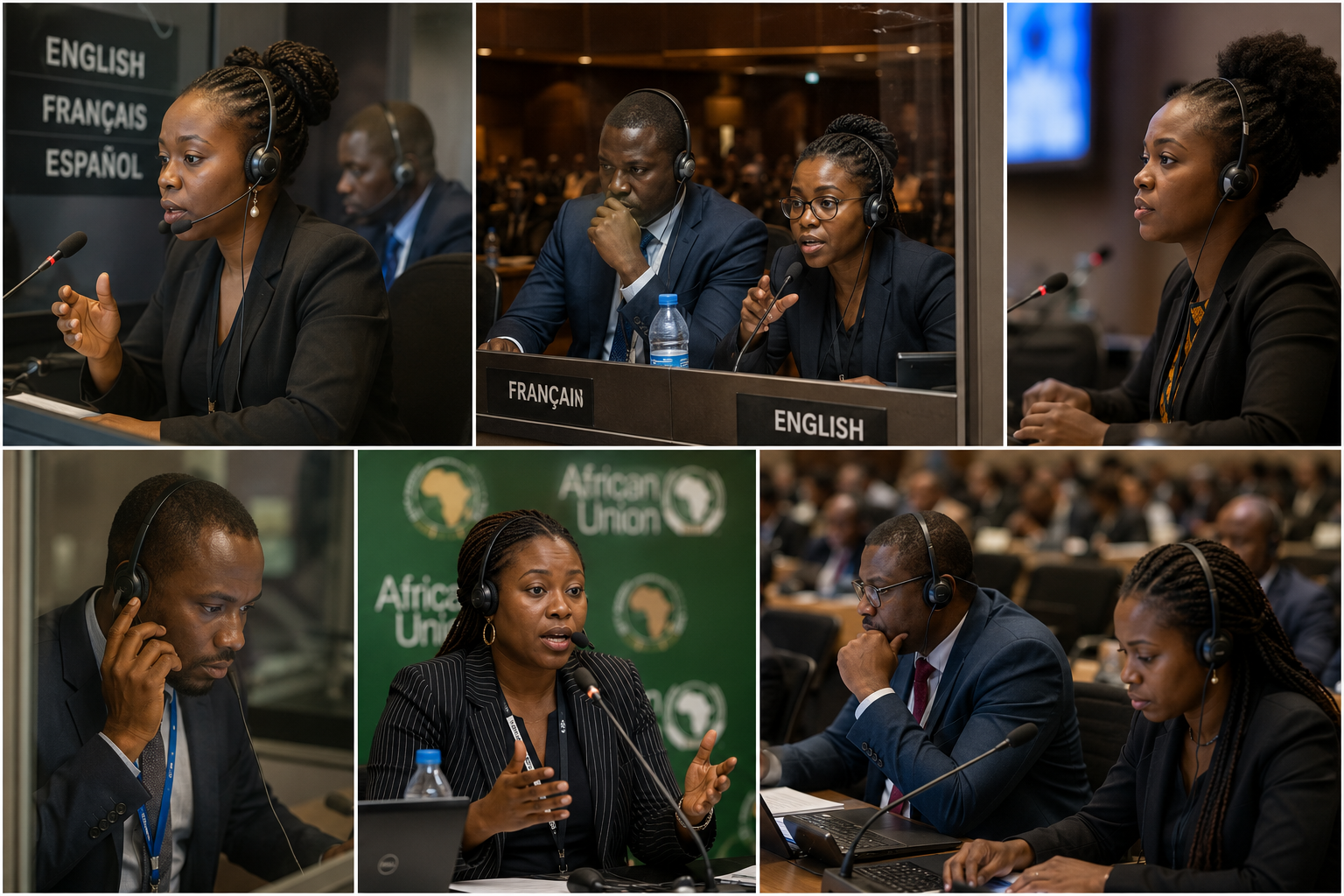
Last week, after a multilingual conference at Movenpick Hotel in Ghana, I spoke with one of the interpreters. She had spent days studying the agenda, building glossaries and coordinating with her booth partner, then interpreted two full days of speeches and panels under sustained cognitive pressure. Her fee barely reflected any of that preparation. Had the African Union, ECOWAS or a UN agency hired her for the same work, she would likely have earned several times more.
This gap is not a Ghanaian problem.
It runs through nearly every conference interpreting market on the continent. Institutional buyers like ECOWAS, UN, World Bank and African Union representations, who test and accredit before they hire, pay professional rates.
Everyone else negotiates in a market with no reliable way to tell a trained conference interpreter from a fluent bystander.
Africa has spent two decades building genuine training capacity. What it has not built, at comparable scale, is an independent system for certifying who among its graduates is ready to work, and a market that knows to ask for that certification. That gap, between education and accreditation, is what keeps a skilled professional’s rate hostage to whichever client happens to be booking her.
The stakes are no longer abstract. The African Continental Free Trade Area brings together 54 countries, over 1.5 billion people and a combined GDP exceeding US$3.4 trillion, making it the largest free trade area in the world by number of participating states.
Every negotiation, arbitration and ministerial meeting under that agreement depends on accurate multilingual communication.
Language is infrastructure for that project in the same way roads and broadband are. The difference is that roads are visible when they are missing. Interpretation is invisible until it fails.
The diploma is not the licence
The confusion at the centre of this problem is a category error common to professions in transition: treating a degree as proof of readiness to practise.
A master’s degree trains someone. Certification tests whether that training produced a competent professional, against a standard set independently of the school that did the training. Europe’s interpreting market makes the distinction unavoidable. Universities recognised by the International Association of Conference Interpreters (AIIC) produce strong graduates, but AIIC membership does not follow automatically from a diploma. Candidates need sponsorship from interpreters who have themselves held AIIC membership for at least five years, followed by peer review. Interpreters seeking work with the European Union or the United Nations face a separate hurdle again: competitive institutional accreditation examinations that ignore where the candidate studied.
Africa’s flagship training pipeline illustrates this well: PAMCIT (Pan-African Consortium for Master’s Degrees in Translation and Conference Interpreting) is implemented by a network of universities designed to equip African language professionals for work in international organisations, the AU, ECOWAS, and other multilingual institutions, and to reduce dependence on training abroad. This is excellent training infrastructure. It is not, on its own, a certification system. There are currently, no PAMCIT-wide accrediting body tests and licenses graduates the way AIIC or the UN does.
Medicine offers the same architecture. Medical schools educate doctors. Medical councils license them. Law school’s educate lawyers. Bar associations admit them to practice. Conference interpreting, wherever it has matured into a recognised profession, has drawn the same line. African interpreting has not yet drawn it consistently, and the cost of that gap is not merely bureaucratic.
Why the distinction is not academic
It is worth being precise about what is actually being tested, because “just speaking two languages” is a genuine and damaging misconception about this profession.
Conference interpreting is among the most cognitively demanding tasks ever studied in a professional setting. A simultaneous interpreter listens, understands, analyses, predicts, reformulates and speaks, while continuously monitoring and correcting their own output, all at once, in real time. Research by scholars including Barbara Moser-Mercer and Daniel Gile has shown this places extraordinary, sustained demand on working memory and executive attention, which is why professional interpreters work in pairs and rotate every twenty to thirty minutes. No pilot flies twelve consecutive hours without relief; a conference organiser who does not know this will not understand why a certified team costs more than a single fluent volunteer.
This is also why institutions such as the UN and the African Union pay considerably more than the open market. They are not paying for language skills alone. They are paying to manage risk: a single inaccurate rendering can distort a treaty clause, a court finding or an investment negotiation. The interpreter is not transmitting words; she is protecting meaning under pressure the client rarely sees. Institutions that test rigorously before hiring are pricing that risk correctly. Markets that do not test at all are pricing it at zero.
Markets, not ministries, set the bar
A common misreading of our industry is that it is unregulated. It is more accurate to say it is regulated by buyers rather than by governments. The EU, the UN, federal courts in the United States and international financial institutions all function as gatekeepers: an interpreter cannot walk into those booths on a transcript alone. In US federal courts for example, I know that certification is a precondition for practice, not a credential acquired afterwards for prestige.
Africa already has working versions of this model. ECOWAS runs its own recruitment, training and evaluation process before adding freelance interpreters to its roster. The African Union applies a comparable competitive procedure. Both are evidence that African institutions already understand quality assurance in principle. What they lack is portability. An interpreter who clears the AU’s bar today may have to clear a separate, unrelated bar for ECOWAS tomorrow, and again for a regional economic community after that, despite the underlying competence being identical
Voluntary accreditation does not solve this on its own
South Africa is usually held up as the continent’s most mature language services market, and the evidence bears that out only partway. The South African Translators’ Institute (SATI), founded in 1956, is Africa’s oldest professional association for translators and interpreters, yet conference interpreting remains legally unregulated even there. SATI accreditation is voluntary and its recommended tariffs are reference points, not enforceable minimums; clients are free to ignore the credential entirely. SATI’s own numbers make the ceiling on voluntary systems visible: roughly 800 members, of whom only about 240 hold formal accreditation. If seventy years has not moved that ratio, the assumption that professional associations will get there eventually is worth retiring.
Cameroon shows the same pattern from the other end. The Association of Translators, Interpreters and Conference Translators of Cameroon (APTIC) has repeatedly noted that language professionals are often treated as administrative support rather than trained specialists, and has proposed minimum fees for private-sector work precisely because no pricing floor currently exists. One freelance translator, Romeo Sakngang Pechama, told me plainly: “People hire translators because they have no choice, not because they see value in what translators bring.” That sentence describes a market that has never shown a credible way to distinguish competence, so it defaults on price.
The training gap has closed. The accreditation gap has not
It is worth being precise about how much has changed on the training side, because the scale of that progress is exactly what makes the certification gap so visible now.
The Pan-African Consortium for Master’s Degrees in Translation and Conference Interpreting (PAMCIT) now spans seven universities: Gaston Berger University in Senegal, the University of Ghana, Universidade Jean-Piaget in Cabo Verde, the University of Lomé in Togo, the University of Buea in Cameroon, the University of Nairobi in Kenya, and Universidade Pedagógica de Moçambique. In November 2025, ECOWAS formally launched PAMCIT’s second phase in Lomé, awarding new scholarships explicitly to reduce the continent’s dependence on training its language professionals abroad. The EU had already committed roughly €4.65 million to the first phase, between 2014 and 2019, making this one of the more serious multilateral investments in African language infrastructure of the last decade.
Set that against the certification side of the ledger. AIIC’s own Africa region currently counts 176 members across the continent, against an organisation with more than 3,000 members in over 100 countries worldwide. Against the thousands of interpreters actively working across Africa’s conference, court and institutional markets, that is a strikingly small formally accredited core, and South Africa’s SATI figures show the shortfall is not confined to AIIC’s narrow peer-sponsorship model.
Henceforth, most African interpreters currently operate with no enforceable quality assurance behind their work at all, whatever their actual competence.
The procurement paradox
Procurement is where this problem shows up most concretely, and it cuts both ways.
On one side, procurement today is part of the problem. Conference interpreting is frequently bought like stationery, on lowest price, by organisations that would never buy legal advice or auditing the same way. Quality interpretation carries real costs: preparation, specialisation, terminology research, teamwork, equipment, continuous training. A tender that ignores all of that and rewards the cheapest bid is not neutral; it actively selects against the professionals who invested in the credentials this article is arguing for.
On the other side, procurement is also the fastest available fix, because markets that already work well enforce standards through tenders rather than statute. The EU and UN do not wait for legislation; they specify accreditation as a contract condition and let the market adjust. African governments, development partners and corporate clients could do the same tomorrow, with no new law required, by writing checkable requirements into tenders: AIIC membership or documented eligibility, national association accreditation, AU or ECOWAS roster status, verifiable experience, evidence of continuous development.
The tension resolves once you see why today’s procurement fails: buyers cannot specify a standard that does not yet exist in a form they can verify.
You therefore see why lowest-price procurement is not a cause of the accreditation gap; it is a symptom of it. A buyer with no reliable way to check a credential default to the one thing they can check, the price. Fix the credentialing problem and procurement stops punishing quality and starts rewarding it, as it already does at the AU and the UN.
Africa cannot regulate what it does not measure
Underneath all of this sits a quieter problem: the near-total absence of market data.
Though they are few data available in ALCA 2026 Research report on the Language Service industry, nobody can say with confidence how many professional conference interpreters are active across Africa, which language pairs face the sharpest shortages, what interpreters earn by country, or how quickly AI-assisted tools are changing demand. No continent-wide report tracks any of this annually, to my knowledge. That absence makes advocacy harder, because governments and regional bodies cannot regulate what they have never measured.
This is where a standing institution would earn its keep. An African Interpreting Observatory, jointly resourced by universities, professional associations and regional bodies, could publish an annual report covering workforce size, rate benchmarks, language demand, certification statistics, procurement practices and AI adoption. For governments, that is evidence for policy. For universities, curriculum guidance. For buyers, a benchmark they can cite in a tender. For interpreters, the data that turns anecdote into advocacy.
For a profession positioned to carry the linguistic weight of Agenda 2063 and the African Continental Free Trade Area, that fragmentation is the more consequential problem, and the more solvable one. The question worth putting to the profession’s own institutions, training providers and buyers is not whether Africa can produce enough qualified interpreters. PAMCIT has already answered that. It is whether Africa is willing to build the system that tells a client, with confidence, which of those interpreters are ready, and pay the interpreter in Ghana accordingly.