Certification for African Language Professionals: What It Really Takes, What It Really Pays, and What Africa Still Needs to Build
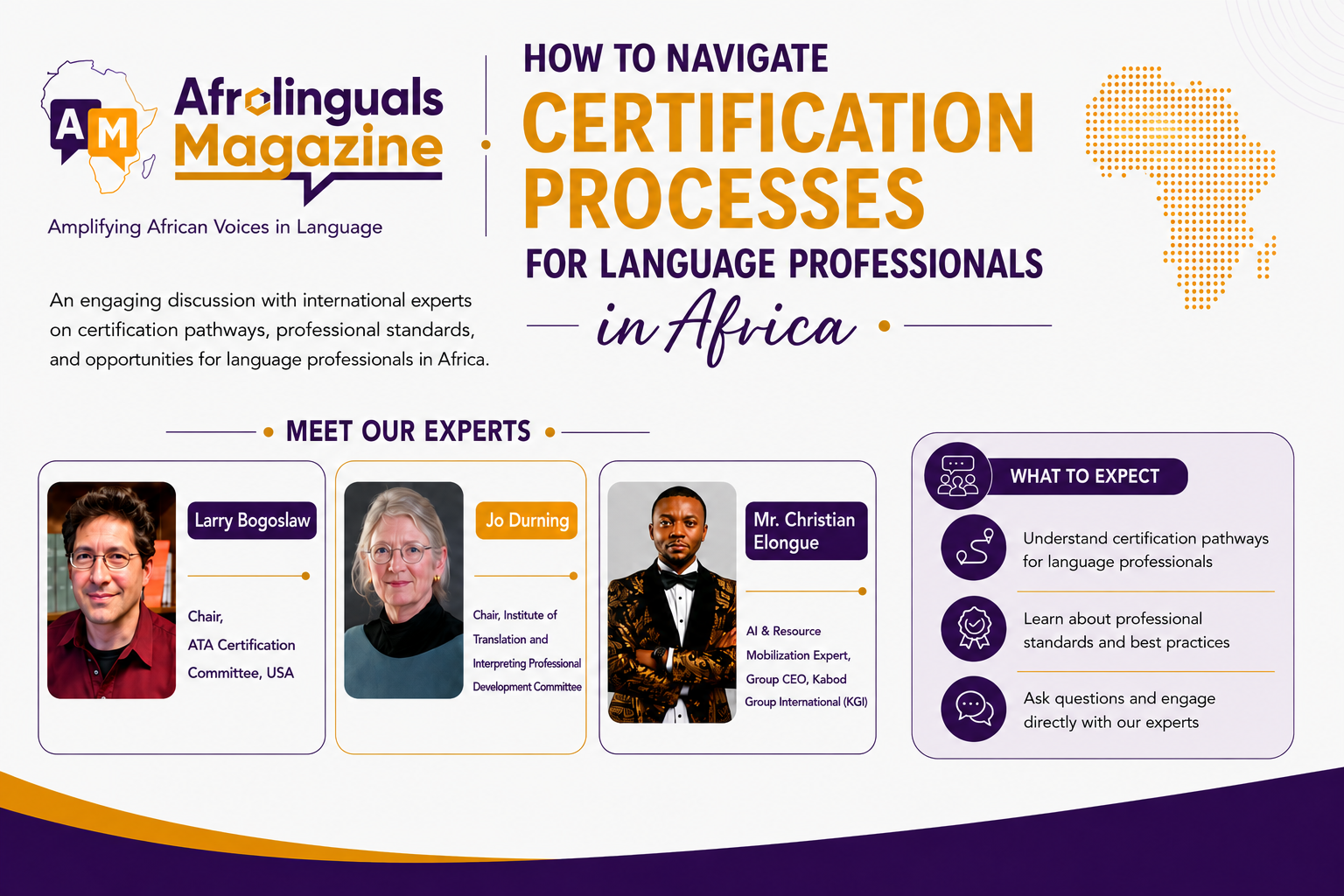
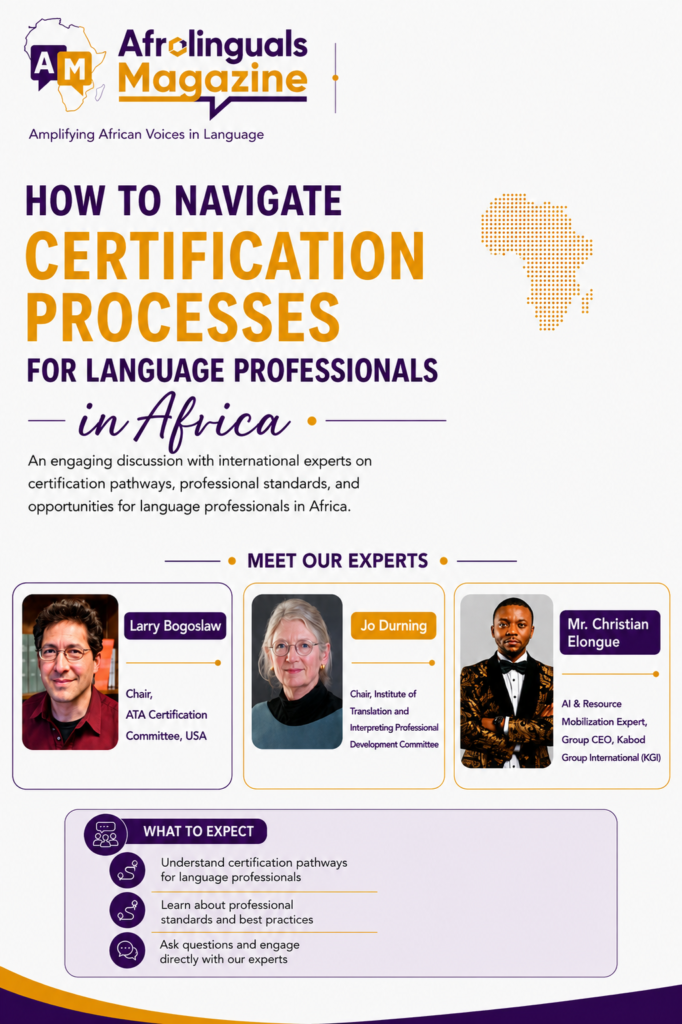
On July 30, 2026, we hosted a webinar on “How to Navigate Certification Processes for Language Professionals in Africa.” We brought together Larry (Laurence) Bogoslaw, Chair of the American Translators Association (ATA) Certification Committee, and Jo Durning, Chair of the Professional Development Committee at the UK’s Institute of Translation and Interpreting (ITI), to exchange with African translators and interpreters on how certification actually works — and what it’s worth.
The conversation could not have been more timely. Every few months, a new AI translation tool promises to make bilingual humans redundant. At the same time, clients from Ghana to Cameroon to Togo keep telling language professionals the same thing: “prove it.” The problem is that in most African countries, there is no local body to prove it to.
This article distills that webinar into the questions African language professionals actually ask when they consider certification. If you’re a translator, interpreter, or language teacher, weighing whether certification is worth your time and money, this is for you.
1. Why this conversation matters right now
Three forces are converging on African language professionals at once.
First, the credibility gap is real and well documented. As I wrote recently, Africa has built genuine training capacity over the last decade — the Pan-African Consortium for Master’s Degrees in Translation and Conference Interpreting (PAMCIT) now spans seven universities, from Senegal to Kenya to Mozambique, backed by roughly €4.65 million in EU funding. What the continent has not built at the same scale is an independent system to certify who among those graduates is actually ready to work.
A degree proves you were trained; certification proves, against a standard set independently of your school, that the training worked. During the webinar, participants from Ghana, Burkina Faso, Cameroon, and Togo echoed this exact gap: plenty of academic credentials, but no clear, authorized pathway to accreditation inside their own countries.
Second, AI is compressing the low end of the market. Bogoslaw confirmed a trend already visible in the US: free machine translation tools have eaten into demand for generic, non-certified work, pushing many translators toward post-editing MT output, while others try to differentiate themselves by marketing services that explicitly avoid AI. Certification, in this environment, stops being a nice-to-have credential and becomes one of the few defensible ways to prove that a human is worth paying for.
Third, the stakes are getting bigger, not smaller. The African Continental Free Trade Area now links 54 countries, over 1.5 billion people, and a combined GDP above US$3.4 trillion: the largest free trade area in the world by number of participating states. Every negotiation, arbitration, and ministerial meeting under that agreement depends on language professionals whose competence someone, somewhere, has verified.
ALCA — founded in August 2023 by Kabod Group, Bolingo Consult, and Folio Online — exists partly to close that gap. It runs the Marketplace for African Translators and Interpreters (MATI) and a LinkedIn community of practice (the Network of African Language Translators and Teachers, ALATT) that now counts more than 5,260 members across both platforms. At the July webinar, ALCA’s members formally prioritized a feasibility study for a home-grown certification framework — which is exactly why we wanted Bogoslaw and Durning in the room first: to understand what already works elsewhere before designing something new.
With that context, let's get into the questions.
1. What is the value of certification for a language professional in Africa?
It signals competence independently of where you studied. Bogoslaw was blunt about this during the webinar: the ATA exam does not test terminology drills, subject-matter expertise, or research skills — it tests whether you can transfer meaning naturally and accurately under exam conditions, judged by graders who have never met you and don’t know your school. That’s precisely the kind of independent verification a client outside your immediate network can trust.
It gives clients a way to find you. Jo Durning pointed out that in the UK, certification is really achieved through tiered membership in bodies like ITI or the Chartered Institute of Linguists (CIOL) — and one of the biggest member benefits is simply being listed in a searchable directory that clients use to verify qualifications before hiring. Africa’s fragmented market, where “who is actually good” spreads by word of mouth or WhatsApp group, is exactly the kind of environment a public, verifiable directory would fix.
And it protects the profession’s own definition of itself. I believe we need to actively promote the value of “Chartered Linguists” the way accountants and bankers protect the prestige of their own titles. If we don’t defend the distinction between a trained professional and a fluent bystander, clients won’t either.
2. Does certification really deliver an economic benefit? Can I charge premium prices?
Yes — with an important caveat about who pays the premium.
Bogoslaw’s own story made this concrete. He failed the ATA exam the first time, went back and specifically trained the transfer skills the test measures, passed on his second attempt, and afterward saw a real jump in both visibility and income — enough that he was able to work as a stay-at-home parent while running a full-time translation career, before eventually moving into an editorial role. That’s not a marketing anecdote; it’s the outcome the exam is designed to produce.
But both speakers were careful about where the premium actually shows up. Durning noted that in the UK, translators who provide certified translations for official use can charge more specifically for that certified service — certification unlocks a category of work (immigration documents, court papers, birth and marriage certificates, university transcripts) that uncertified translators simply cannot legally sign off on. Bogoslaw added that large corporate clients often set their own rates regardless of credentials, but smaller, better-informed clients — the ones who understand what translation actually requires — are the ones most likely to pay for certified professionals, because “the industry is built on client trust.”
The uncomfortable finding from Africa’s own market data reinforces this. In a recent article, a Cameroonian translator, Romeo Sakngang Pechama, put the market’s current logic plainly: clients hire translators because they have no alternative, not because they recognize the value translators bring. That is a market pricing competence at zero — exactly the condition certification exists to correct. Where no credible way to distinguish competence exists, price becomes the only variable buyers can act on, and it collapses toward the bottom.
3. What does it cost to become a certified language professional in my field?
Costs vary by country and body, and they compound — membership plus exam plus preparation plus renewal.
American Translators Association (US):
Associate membership (required before you can sit the exam): roughly $195–$245/year
Certification exam fee: $525 for your first language pair (about $325–$375 for members registering additional pairs, versus higher fees for non-members)
Optional: a graded practice test, at additional cost, that returns detailed feedback — unlike the real exam, which does not return your marked paper if you fail
Ongoing: continuing education to maintain certification
UK routes (ITI / CIOL):
ITI Qualified (MITI) membership: a one-off £60 (+VAT) application fee, a £165 (+VAT) Translation Portfolio Assessment for new applicants, and an annual MITI membership fee of £277
CIOL Associate membership: roughly £162/year (with a first-year discount for fast-track applicants who already hold qualifying credentials)
Progression to full Member (MCIL) or Chartered Linguist status adds no extra fee beyond meeting experience requirements, but requires 2–3 years of relevant, verifiable work experience
Add exchange-rate exposure, international card fees, and the cost of a stable internet connection for a proctored online exam, and the real cost for an African applicant is meaningfully higher than the sticker price suggests. This is one of the strongest arguments for building a lower-cost, regionally priced African alternative.
4. Where do I go, in my country or in Africa, if I want to be certified?
In most African countries, there is currently no dedicated, government- or industry-backed certification body for translators or interpreters. This was the barrier participants from Ghana, Cameroon, and Togo raised repeatedly during the webinar; plenty of degrees, unclear or non-existent pathways to formal accreditation at home.
A few partial exceptions exist, and they're worth knowing about:
South Africa’s SATI (South African Translators’ Institute), founded in 1956, is Africa’s oldest professional association for translators and interpreters and does offer voluntary accreditation. But its own numbers show the limits of a voluntary system: of roughly 800 members, only about 240 hold formal accreditation — after nearly 70 years.
National associations elsewhere (like APTIC in Cameroon) document the problem and propose fee floors, but do not yet run certification exams of their own.
Institutional accreditation exists at the buyer level. ECOWAS and the African Union both run their own testing and evaluation processes before adding interpreters to their rosters — proof that African institutions already know how to assess competence. The catch is portability: passing ECOWAS’s bar doesn’t carry over to the AU’s, or to a regional economic community’s, even though the underlying skill is identical.
AIIC’s Africa region (the International Association of Conference Interpreters) counts 176 members on the continent, against more than 3,000 members worldwide — a small, sponsorship-gated core relative to the number of working interpreters.
ALCA’s own conference, scheduled for August 27–28, 2026, at the AH Hotel in East Legon, Accra, is intended as a working session to move the feasibility study for a homegrown African certification framework forward. Until something like that exists at scale, most African professionals seeking a credential currently look abroad.
5. Is certification or accreditation valid beyond my own country?
It depends on what you mean by “valid,” and this is where the US and UK models genuinely differ.
The ATA credential travels reasonably well internationally because it’s issued by a body with members in over 100 countries and is widely recognized as one of the industry’s most respected credentials — but it is a US-based, language-pair-specific exam, not a government license, so its authority rests on reputation rather than legal force.
The UK model is more locally anchored. Translation is not a legally regulated profession in the UK — Durning was explicit about this — so “certification” there really means membership in good standing with a recognized body like ITI or CIOL, which is a UK institutional credential first and an internationally recognized one second.
Interestingly, the two systems do partially recognize each other: CIOL’s own admissions criteria list “ATA Certified” as one of several qualifying pathways to fast-track Associate membership, alongside ITI assessment and specific diplomas. That cross-recognition is a useful precedent for whatever African certification body eventually emerges — it suggests a new African credential could, over time, negotiate similar mutual recognition with ATA, ITI, or CIOL, rather than starting from zero credibility.
What neither credential does automatically is unlock legal authority in a third country. An ATA certification does not make you a “sworn translator” in France or Germany, and an MITI does not automatically satisfy a court’s requirements in Kenya. Validity beyond your home market is really a question of whether the specific client or institution you’re working with recognizes the specific body that certified you — which is exactly why directories, procurement language, and mutual-recognition agreements matter as much as the exam itself.
6. What are the processes and costs involved for someone based in Africa?
Practically, here's what pursuing ATA or ITI/CIOL certification looks like from Africa today, based on what Bogoslaw and Durning described:
Join the relevant association first. Both the ATA exam and ITI/CIOL qualified membership require you to be a member before you can be assessed.
Take it entirely online. Since 2021, the ATA exam has been available as an on-demand, remotely proctored online exam — no travel to the US required. Candidates register through the ATA website and have 30 days from registration to sit the 3-hour, live-proctored, recorded exam.
Prepare deliberately. Bogoslaw was candid that most failures aren’t about bilingualism — they’re newcomers assuming fluency is enough. The ATA’s overall pass rate sits below 20%. The single best predictor of readiness the ATA offers is its graded practice test, which — unlike the real exam — is returned to candidates with detailed, categorized feedback.
Build a portfolio for ITI, not just a test score. The MITI route is not a single exam; it’s degree or diploma evidence, 3+ years of professional experience (6 without a degree), references, published work in your target language, a Code of Conduct assessment, and 30 hours of documented continuing professional development (CPD).
Budget for indirect costs. Study guides, prep courses, translated document notarization if required, currency conversion losses, and reliable high-speed internet for a monitored online exam all add to the sticker price above.
Maintain it. Both systems require ongoing CPD or continuing education to keep the credential active — certification is a floor you keep clearing, not a one-time achievement.
7. Will AI make certification less necessary — or more?
This came up directly in the webinar, and the answer both speakers converged on was: more, not less.
Free machine translation has already eroded the market for generic, non-certified work — Bogoslaw confirmed this is measurable in the US market, with many translators shifting toward post-editing MT output rather than translating from scratch. But that shift actually raises the value of independently verified human judgment for the work that still requires it: legal documents, official certificates, literary and creative texts, anything where an error carries real consequence. A credential that proves you can catch what MT gets wrong — and write naturally rather than mechanically — becomes more valuable precisely because AI has made “I speak two languages” a commodity. Some translators are now marketing themselves explicitly as AI-free specialists, which only works if there’s a credible, independent way to back that claim up.
8. What can African language professionals do right now, while the continent builds its own system?
Waiting for a fully-formed African certification body could take years. In the meantime:
Pursue ATA or ITI/CIOL certification directly — both are now fully accessible online from anywhere on the continent, and both are internationally legible credentials clients recognize, even without a local proctoring center.
Take the practice test before the real exam. It’s the one part of the ATA process specifically designed to tell you, cheaply, whether you’re ready — with real feedback on what to fix.
Join the communities already doing the groundwork. MATI marketplace and the ALATT community of practice exist precisely to connect African professionals with opportunities and each other while formal infrastructure catches up — and the upcoming ALCA conference (Accra, August 27–28, 2026) is a direct channel into the feasibility study for an African certification framework.
Push procurement language, not just personal credentials. As I’ve argued elsewhere, the fastest fix isn’t waiting for legislation — it’s African governments, development partners, and corporate clients writing checkable accreditation requirements into their tenders, the way the EU and UN already do. That single change would let the market reward certified professionals immediately, without waiting for a new institution to be built from scratch.
Watch for impersonation. Both ATA and UK bodies maintain public verification tools precisely because fake seals and misrepresented qualifications are a real problem; if you’re certified, make sure clients can actually check it, and if you’re hiring, always verify through the official directory rather than a claimed credential alone.
Where this leaves the conversation
The webinar ended, fittingly, with more open questions than answers:
Should Africa build one continental certifying body, or accredit national ones under a shared standard — the way medicine has national boards but a shared underlying science? The ECOWAS/AU precedent shows African institutions can already assess competence; the missing piece is portability between them.
Who pays for it, and who governs it? SATI’s 70-year plateau at roughly 30% accreditation among its own members suggests that voluntary, association-run certification alone may not be enough — but a state-run one risks the political capture that makes buyer-driven, procurement-based standards (like the EU and UN model) attractive in the first place.
Can an African credential achieve mutual recognition with ATA, ITI, or CIOL from day one, the way CIOL already fast-tracks ATA-certified applicants — rather than spending a decade building independent credibility?
How does certification design account for African-language pairs that ATA and ITI, built around European and major world languages, were never designed to test?
What role should an African Interpreting/Translation Observatory play in generating the workforce and rate data — currently almost entirely absent continent-wide — that any credible certification body would need to set standards and prove its value to skeptical buyers?
None of these questions have easy answers. But for the first time, thanks to conversations like this one, they’re being asked by people with the standing — ATA’s own certification chair, ITI’s professional development chair, and a growing community of African language professionals — to actually answer them. That’s worth building on.
Christian Elongué is Chief Editor of Afrolinguals Magazine, founder of the Marketplace for African Translators and Interpreters (MATI) and the Network of African Language Translators and Teachers (ALATT), and a co-founder of the Association of Language Companies in Africa (ALCA). He writes regularly about the African language industry for Slator, MultiLingual, and Kabod Group.
Related reading:
- “Building the African Language Industry, One Project at a Time” — MultiLingual Magazine
- “Why Africa’s Interpreters Need Accreditation, Not Just Training” — Kabod Group