The language industry globally is in the middle of a talent re-sorting, and Africa's version of that re-sorting looks structurally different from what's happening in Europe or North America.
Globally, what's in demand right now?
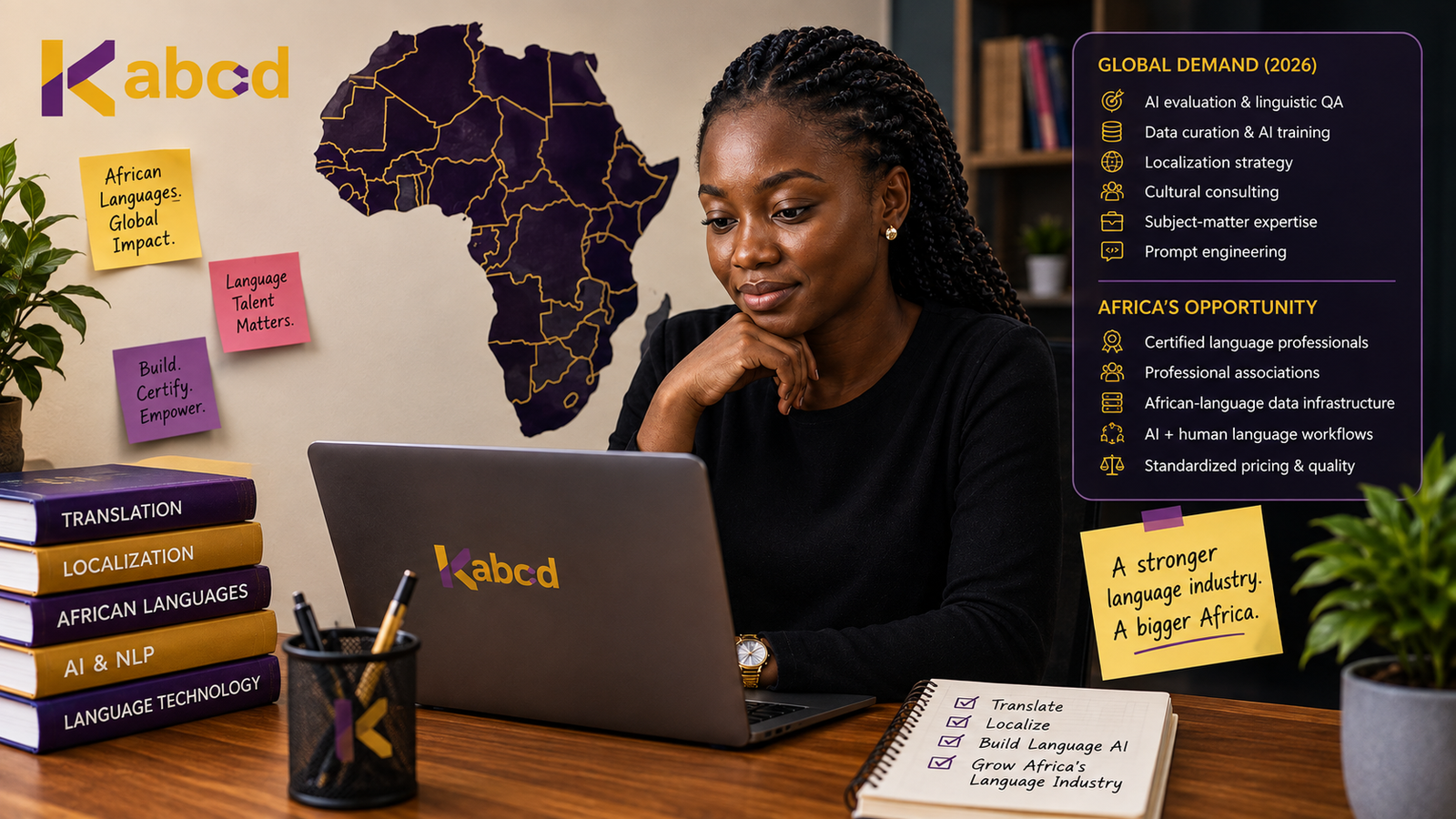
The center of gravity has shifted away from high-volume, entry-level translation (AI absorbed most of that) toward oversight and judgment roles. I noticed language companies are increasingly hiring computational linguists, AI trainers and data curators, and what Nimdzi’s 2026 industry report calls “AI conductors”: experienced linguists who validate, audit, and correct machine output rather than producing it from scratch.
Alongside that sit cultural consultants and localization strategists, who bring the contextual judgment machines can’t, and subject-matter specialists in regulated domains like legal, medical, and financial translation, where liability makes human accountability non-negotiable.
Prompt engineers who can bridge linguistic and technical fluency are commanding premium rates. The Nimdzi report notes that only about 11% of language companies currently have a strong technology focus, which tells you the demand for people who can build and manage that infrastructure is running well ahead of supply.
The uncomfortable side of this shift: entry-level roles that used to train the next generation of translators are disappearing, and experienced linguists are leaving the profession because post-editing AI output is unsatisfying work. So even in mature markets, there’s a looming talent pipeline problem, not just a skills problem.
Africa's gap is a different, more foundational one
Where the global industry is grappling with how to reskill an existing workforce, most of Africa is still building the institutional scaffolding that workforce would sit on. A few things stand out from the research I contributed in for the Association of Language Companies in Africa (ALCA):
1. Training has expanded faster than certification.
Programs like PAMCIT now span seven universities, but independent accreditation lags badly behind. Kabod Group's own research found that the International Association of Conference Interpreters lists only 176 African members across a continent with thousands of active interpreters, meaning most African interpreters operate with no enforceable quality standard behind their credentials. A degree trains someone; certification is a separate, independently governed test of whether that training produced a competent professional. Africa hasn't built that second layer at scale.
2. Industry associations are mostly under-resourced.
Professional associations, which normally carry that certification and standard setting function, are themselves under resourced.
Across the continent there are roughly 20 translator and interpreter associations, and by Kabod Group’s assessment only about 15% qualify as institutionally mature, with 40% still at an emergent stage. They’re squeezed by weak dues bases, limited digital infrastructure, and an inability to set standard pricing because unregistered freelancers keep undercutting the market. Less than 20% of language professionals on the continent have access to accredited training at all.
3. Not enough trained linguists who can own and maintain tools and data infrastructure in African languages
Outside South Africa, translation as an organized industry barely exists in most sub-Saharan countries. Translators without Borders has documented how this plays out concretely: critical health information around outbreaks or disease prevention often only exists in colonial languages, unreadable to the rural populations who need it most, because there simply aren’t enough trained translators for the local language pair, and the ones who exist often lack basic tools like technical glossaries.
There’s also a technology and data gap that’s specific to African languages rather than the industry broadly. With over 2,000 languages on the continent, most are what NLP researchers call low-resource: little digitized text, little annotated speech data, and a real shortage of native speaker linguists trained to do language identification, transcription quality assessment, and digitization of material that currently exists only in print. CLEAR Global’s work on African speech recognition is explicit that this bottleneck isn’t compute, it’s trained human expertise, particularly regional linguists who can own and maintain the data infrastructure rather than have it built and held externally.
Public sector interpreting shows the same pattern at ground level. South Africa’s courts have around 1,824 appointed interpreters (only about 20 for sign language) and are still short, partly because there’s no centralized registry of accredited practitioners and demand keeps expanding into “obscure” language pairs the system wasn’t built for. Sign language interpreting in particular remains largely unprofessionalized across much of the continent, as documented in the Cameroon case.
Conclusion
I believe Africa has real linguistic talent and a lot of goodwill and training activity, but the institutional architecture around that talent (certification bodies, pricing standards, data infrastructure, coordinated associations) is thin.
That’s less a talent shortage than an ownership and systems gap: the capacity exists in fragments, but the standards, accreditation, and market infrastructure that would let it function as a real profession and command fair value haven’t been built locally yet. And that’s something I’m intentionally and consistently building through ALCA, ALATT, MATI and Afrolinguals, communities of language professionals who believe in a brighter future for the language industry in Africa.